

Pine Script

TradingView Pine Script Development

Custom Pine Script programming for TradingView — indicators, strategies, alerts, and publishing support. We convert ideas into Pine Script code, validate it with backtests and robustness checks in TradingView’s strategy tester, and prepare publishable studies.

TradingView

What we do

The most common TradingView projects clients bring us — from one-hour fixes to complete systems.

Strategy design & implementation

Pine Script strategies with entry/exit rules, position sizing and risk logic.

Modular development

Reusable components that speed testing, reduce bugs and simplify updates, integrating cleanly with TradingView.

Indicator development

Custom Pine indicators, multi-timeframe logic and on-chart visualization.

Alerts & webhook integration

Configurable alerts with customizable webhook payloads for automated workflows.

Backtesting & robustness checks

Strategy-tester backtests, parameter sweeps and sensitivity checks.

Code review & optimization

Simplify scripts to avoid repainting and ensure correct bar-replay handling.

AI-generated code hardening

Review and harden AI-written Pine Script: fix repainting and look-ahead bias, correct alert and webhook behavior, and deliver tested, deployable code.

Publishing & access control

Helper code and notes for public and invite-only indicators.

Ongoing support & maintenance

Hourly support or retainer plans for updates, bug fixes and adapting strategies as market structure changes.

NDAs available on request.

What Pine Script looks like

A simple demonstration of a moving-average crossover. Production projects add documentation, input validation and a change log.

MA Cross Alert — Pine Script
//@version=6
indicator("MA Cross Alert", overlay = true)

fastLen = input.int(10, "Fast length")
slowLen = input.int(50, "Slow length")

fastMa = ta.sma(close, fastLen)
slowMa = ta.sma(close, slowLen)

plot(fastMa, "Fast MA", color = color.new(color.blue, 0))
plot(slowMa, "Slow MA", color = color.new(color.orange, 0))

if ta.crossover(fastMa, slowMa)
    alert("Fast MA crossed above the slow MA", alert.freq_once_per_bar_close)

Why our TradingView work stands out

  • Pine Script specialists with hands-on trading experience.
  • Production reliability focus — defensive coding, robust error handling and clear versioning.
  • Configurable risk controls — position sizing, stop logic and real-world order management available on request.
  • Trader-focused deliverables — readable source code, clear setup guides and reproducible backtest reports.

Typical engagement

  1. Intake & objectives

    We hold an intake meeting to define instruments, timeframe and risk limits, and review any sample data or scripts you provide.

  2. Functional spec & estimate

    You receive a written scope with deliverables, milestones and an estimated range of hours, plus checkpoints and transparent time tracking.

  3. Development & review

    We implement the agreed specification in Pine Script and walk you through the results for approval.

  4. Validation (optional; recommended for strategies)

    We run in-sample / out-of-sample backtests, walk-forward tests and sensitivity analysis.

  5. Handover

    You receive the final Pine Script source code, documentation and test results.

  6. Deployment support (optional)

    We assist with broker checks, paper-trading runs and go-live readiness, with the option of ongoing support.

Projects are billed hourly; estimates follow scoping. We notify you upfront if work is likely to exceed the initial estimate.

Deliverables you receive

  • Pine Script source code with inline comments — stress-tested and validated in-house.
  • Deployment & user guide (PDF): input descriptions, setup instructions, Pine Script version notes, and data-feed/broker settings.
  • Backtest report (optional): equity curve, drawdown, trade stats and a brief plain-English interpretation.
  • Robustness checks (optional): parameter-sensitivity, out-of-sample, cross-instrument and timeframe-stability checks.
  • Versioned release and change log.

Case studies

Anonymized examples of TradingView projects we have delivered.

Multi-timeframe strategy with scaling & risk controls

Volatility-adjusted position sizing

Algorithmic trader Development effort ≈60 hours

Problem
Manual scaling and static sizing produced inconsistent risk exposure across changing market regimes, causing unbalanced drawdowns.
Solution
A Pine Script strategy framework that evaluates multiple timeframes and classifies trend strength; implements configurable scale-in/scale-out rules (pyramiding, fixed scale, ATR-sized increments); and applies dynamic position sizing with risk-based rebalancing. Visual trade markers and an on-chart state display support quick review.
Outcome
Repeatable, volatility-aware entries and exits with controlled scaling and rebalancing, reducing drawdown variability and manual adjustments.
Deliverables
Pine Script strategy, deployment checklist, user guide.
Fundamental & technical research dashboard

Unified on-chart research workflow

Independent researcher Development effort ≈45 hours

Problem
The analyst switched constantly between fundamentals and charts, causing slow reconciliation and fragmented research.
Solution
A TradingView on-chart dashboard that overlays fundamentals alongside technical panels with easy-to-select metrics (earnings, P/E, revenue growth; momentum, volatility, multi-timeframe S/R). Built-in presets and consistent layouts apply the same metric set across symbols and timeframes, with on-chart annotations that stay tied to the chart view.
Outcome
Faster idea vetting and a consistent research display that preserves context across snapshots and sessions.
Deliverables
Dashboard indicator, user guide, quick-start install checklist.

Price-action swing detection

Consistent multi-timeframe pivots

Independent trader Development effort ≈30 hours

Problem
Inconsistent pivots across timeframes created noisy signals.
Solution
A multi-timeframe pivot engine with ATR/volume filters and strength scoring.
Outcome
Clearer entries and reduced noise.
Deliverables
Price-action swing indicator, user guide.

Multi-timeframe support/resistance monitoring

Strength-ranked, persistent S/R levels

Retail trader Development effort ≈25 hours

Problem
Keeping support/resistance levels current by hand was slow, and levels went stale.
Solution
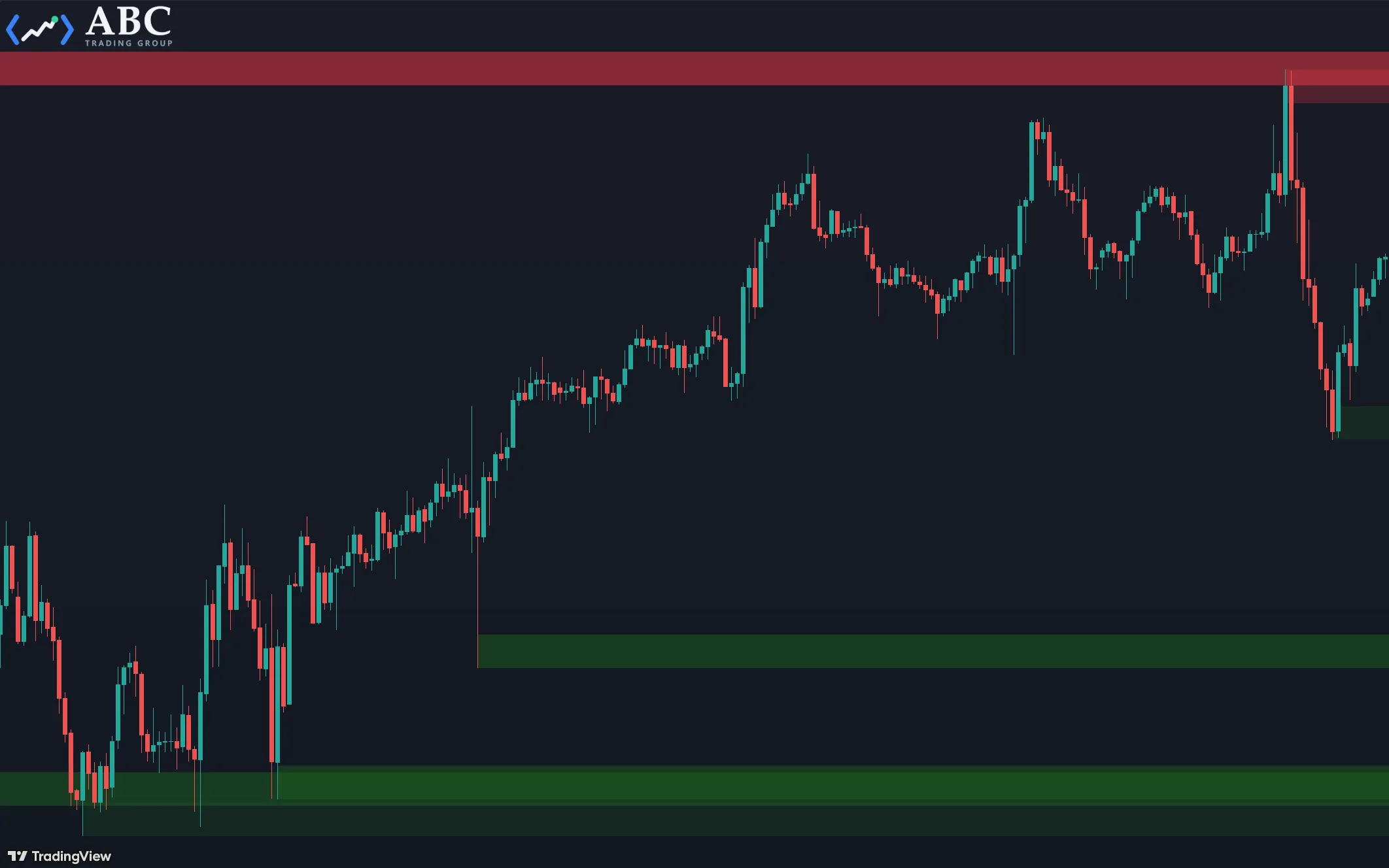
Consolidated multi-timeframe S/R detection with scoring, decay, and alerts.
Outcome
Faster preparation and fewer missed setups.
Deliverables
S/R indicator, user guide.
Dark TradingView candlestick chart with the multi-timeframe support/resistance indicator drawing a red resistance zone above price and layered green support zones below the current market.

Automated open-gap monitoring

Persistent gap tracking with alerts

Retail trader Development effort ≈12 hours

Problem
Manual gap tracking was impractical.
Solution
Session-gap detection with persistent markers, configurable alerts, and the option to remove closed gaps from the display.
Outcome
Streamlined session prep and clearly visible gap opportunities.
Deliverables
Gap-monitor indicator, user guide.

Volume-profile naked (virgin) POC tracker

Automated naked-level management

Prop trader Development effort ≈20 hours

Problem
Manual tracking of untouched (naked) levels was laborious.
Solution
Session/swing profiles that detect, display, and decay naked POC, HVN, and LVN levels automatically.
Outcome
Focused support/resistance levels and reduced manual prep.
Deliverables
Volume-profile indicator, user guide.

Pricing guide

Indicative ranges. Every project is quoted after scoping.

Indicators / Pine studies

$500 – $1,200

Single strategy (spec, backtest, deployment guide)

$1,200 – $4,000

Complex alerting integrations / multi-instrument systems

$4,000+ (custom quote)

Projects are billed hourly. A final quote follows scoping and review of any existing code. Retainer and ongoing-support options are available and priced in proposals.

Frequently asked questions

What are typical timelines?

Simple indicators — days; strategies — 1–3 weeks; complex systems — 4–10+ weeks.

Can you work with existing code?

Yes. We routinely take over, rescue and improve Pine Script projects: diagnose issues, fix bugs, refactor for clarity and speed, extend functionality, and deliver tested, deployable code.

Can you fix code I generated with ChatGPT, Claude or another AI?

Yes — and you’re in good company; it’s one of our most common requests. AI tools are a quick way to prototype an idea, but the generated Pine Script is often unsafe to trade as-is: typical issues include repainting, look-ahead bias that flatters backtests, fragile order handling and missing risk controls. We review the code against the rules you intended, fix what’s broken, harden it for live conditions and validate the result with proper testing. Send us the code and a short description of what it should do, and we’ll take it from there.

Which Pine Script version do you use?

We develop against the current Pine Script version, can migrate older v4/v5 scripts, and note version-specific caveats in deliverables.

Do I receive the source code?

Yes. Every project is delivered as documented, readable source code — not a compiled black box — together with usage instructions.

Do you guarantee profits?

No. You get reproducible testing, documented assumptions and deployment best practices — but no performance guarantees.

Is an NDA available?

Yes — available on request. Independent of any NDA, nothing you share is disclosed to a third party without your prior written consent.

Technical notes & best practices

  • Every delivery includes a PDF manual covering inputs, settings, usage and deployment steps, alongside inline code comments and a change log.
  • Backtests include reproducible scripts and data-range notes for independent verification.
  • Strategy code is written to prevent repainting and look-ahead bias, handle bar replay correctly, and document intrabar execution caveats.
  • Pine Script studies are audited for common repainting sources — request.security() lookahead, calc_on_every_tick effects and bar-state assumptions — before delivery.
  • Alerts and webhook payloads are tested end-to-end, including alert frequency and once-per-bar-close behavior.
  • Scripts are written with TradingView’s resource limits in mind — execution time, drawing-object and data-request limits — so they stay stable on large watchlists.

Ready to turn your idea into working TradingView code?

Book a free 15-minute consultation to discuss scope, timeline and pricing. We respond within one business day — often the same day.