

EasyLanguage / OOEL

TradeStation EasyLanguage Development

Custom EasyLanguage and Object-Oriented EasyLanguage (OOEL) programming for production trading — strategies, indicators, optimization, backtesting, and live-deployment support. We deliver classic EasyLanguage scripts, modular OOEL components, and integration with TradeStation features such as RadarScreen, the Optimization API, and Portfolio Maestro.

TradeStation

What we do

The most common TradeStation projects clients bring us — from one-hour fixes to complete systems.

Strategy design & implementation

Specification, coding and deployment of automated strategies: entry/exit, money management, position sizing and trade filters.

OOEL development

Modular, object-oriented implementations for reusable components, improved testability and cleaner integration with chart objects and RadarScreen.

Custom indicators & visual studies

PaintBars, ShowMe studies, multi-timeframe indicators and on-chart instruments for faster decisions.

Backtesting & optimization

Rigorous historical testing across parameter settings, walk-forward validation and robustness checks.

Code review & performance tuning

Refactor legacy scripts, remove repainting logic, and optimize loops and data handling to reduce CPU use and improve execution accuracy.

AI-generated code hardening

Review and harden AI-written EasyLanguage/OOEL: fix look-ahead and intrabar order issues, add risk controls, and deliver tested, deployable code.

Broker & execution readiness

Paper-trade setup, live-simulated runs, and checks for order types, fills and slippage handling.

Ongoing support & maintenance

Hourly support or retainer plans for updates, bug fixes and adapting strategies as market structure changes.

NDAs available on request.

What EasyLanguage looks like

A simple demonstration of a moving-average crossover. Production projects add documentation, input validation and a change log.

MA Cross Strategy — EasyLanguage
Inputs:
    FastLength(10),
    SlowLength(50);

Variables:
    fastAvg(0),
    slowAvg(0);

fastAvg = Average(Close, FastLength);
slowAvg = Average(Close, SlowLength);

if fastAvg crosses over slowAvg then
    Buy ("MA Cross LE") next bar at market;

if fastAvg crosses under slowAvg then
    Sell ("MA Cross LX") next bar at market;

Why our TradeStation work stands out

  • Registered TradeStation EasyLanguage specialists with hands-on trading experience.
  • Production reliability focus — defensive coding, robust error handling and clear versioning.
  • Configurable risk controls — position sizing, stop logic and real-world order management available on request.
  • Trader-focused deliverables — readable source code, clear setup guides and reproducible backtest reports.
TradeStation EasyLanguage Specialist — Independent Consultant

Typical engagement

  1. Intake & objectives

    We hold an intake meeting to define instruments, timeframe and risk limits, and review any sample data or scripts you provide.

  2. Functional spec & estimate

    You receive a written scope with deliverables, milestones and an estimated range of hours, plus checkpoints and transparent time tracking.

  3. Development & review

    We implement the agreed specification in EasyLanguage / OOEL and walk you through the results for approval.

  4. Validation (optional; recommended for strategies)

    We run in-sample / out-of-sample backtests, walk-forward tests and sensitivity analysis.

  5. Handover

    You receive the final EasyLanguage / OOEL source code, documentation and test results.

  6. Deployment support (optional)

    We assist with broker checks, paper-trading runs and go-live readiness, with the option of ongoing support.

Projects are billed hourly; estimates follow scoping. We notify you upfront if work is likely to exceed the initial estimate.

Deliverables you receive

  • EasyLanguage/OOEL source code with inline comments — stress-tested and validated in-house.
  • Deployment & user guide (PDF): input descriptions, setup instructions, TradeStation version notes, and data-feed/broker settings.
  • Backtest report (optional): equity curve, drawdown, trade stats and a brief plain-English interpretation.
  • Walk-forward summaries where applicable.
  • Versioned release and change log.

Case studies

Anonymized examples of TradeStation projects we have delivered.

Automated research engine

Research time reduced from hours to minutes

Quantitative retail trader Development effort ≈80 hours

Problem
Manual screening of large watchlists took hours and missed cross-sectional opportunities.
Solution
A modular TradeStation research engine (EasyLanguage / OOEL) that applies fundamental and technical filters with cross-sectional ranking to return a ranked list of top instruments, plus a chart-cycler UI for rapid visual review. Saved scan configurations and clear inputs make adjustments easy for non-programmer traders.
Outcome
Research runs in minutes, higher-quality setups are surfaced consistently, and reusable modules speed future changes.
Deliverables
Source code, deployment checklist, saved scan configurations, user guide.
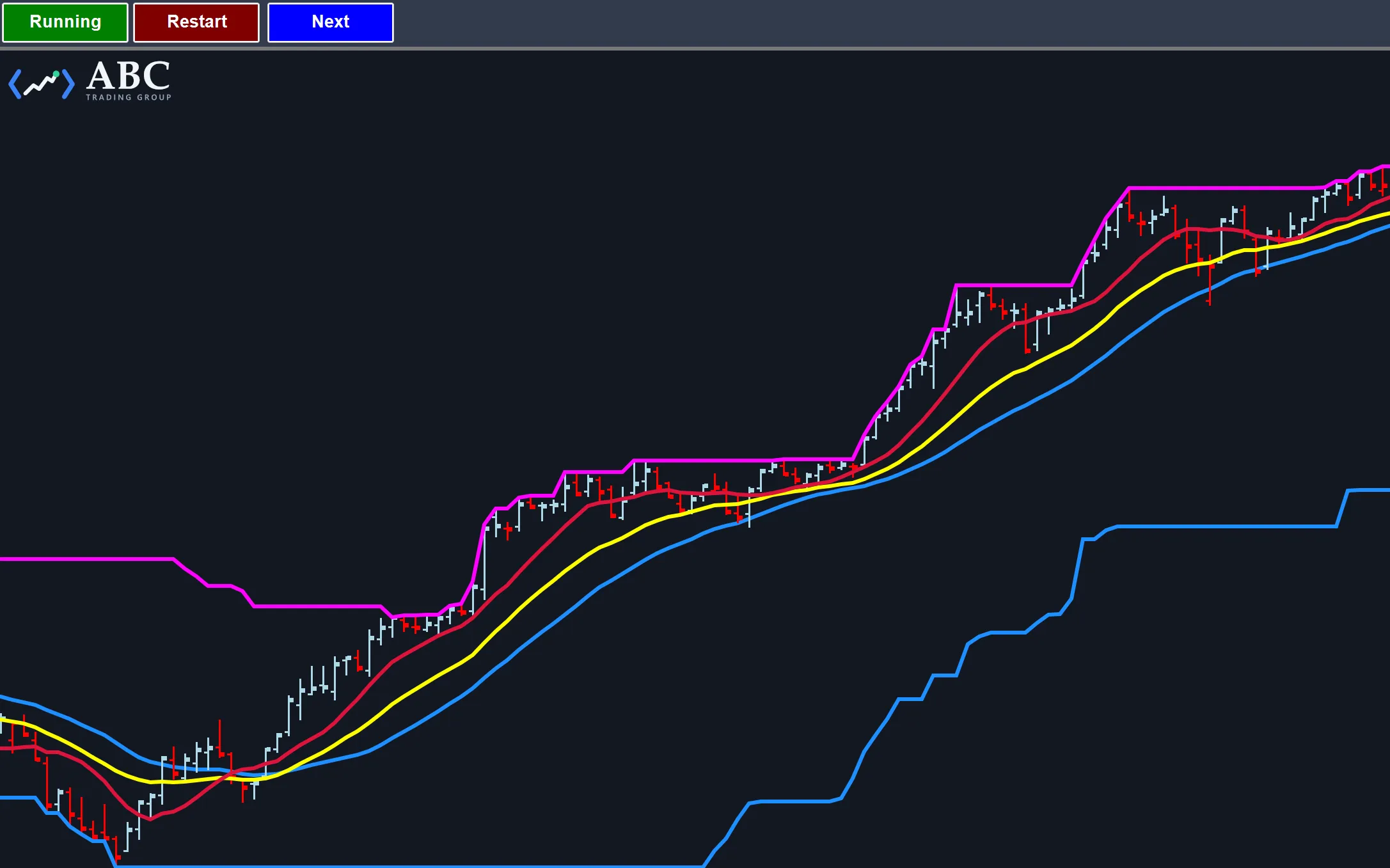
Dark TradeStation chart driven by the research engine: an uptrending market with bold layered moving averages and stepped trailing levels, with the chart-cycler’s Running, Restart and Next buttons in the toolbar.

Interactive Chart Trader

Execution repeatability increased

Discretionary trading firm Development effort ≈60 hours

Problem
Manual order entry from chart drawings delayed execution, introduced errors, and prevented reliable testing of drawing-based signals.
Solution
An Interactive Chart Trader that captures mouse-drawn annotations (trendlines, boxes, arrows), maps them to configurable order templates (entry/stop/limit/OCO), and includes confirmation rules, basic validation, and a backtest mode for drawing-triggered orders. Configurable defaults and a simple setup guide let traders replicate drawing-to-order workflows across symbols.
Outcome
Faster, more consistent execution from visual setups; the ability to backtest and iterate drawing-based strategies; fewer manual-entry errors.
Deliverables
Source code, deployment checklist, user guide, configuration examples.

Virtual advanced bar types

Backtest fidelity improved

Quantitative / short-term strategist Development effort ≈40 hours

Problem
Non-standard bars produced spurious signals and over-optimistic backtests.
Solution
Virtual bar types that reconstruct tick dynamics and intrabar price paths for realistic execution simulation and intrabar backtesting.
Outcome
More accurate, tick-level backtests.
Deliverables
Virtual-bar module, strategy source, validation report.

Anchored VWAP

Multi-anchor intraday context

Intraday / price-action trader Development effort ≈10 hours

Problem
Manually comparing multiple VWAP anchors was slow and error-prone.
Solution
Multi-anchor Anchored VWAP with one-click draw/delete, configurable bands/methods, and chart-state persistence.
Outcome
Quicker VWAP comparisons.
Deliverables
Indicator code, usage guide, example workspace.

Multi-timeframe RadarScreen

Real-time multi-timeframe signals

Watchlist-driven day trader Development effort ≈20 hours

Problem
RadarScreen was limited to a single timeframe.
Solution
PriceSeriesProviders that load additional timeframe and symbol data for indicator computations.
Outcome
Real-time multi-timeframe screening in RadarScreen.
Deliverables
Indicator code, user guide.

Customizable email notifications

Rich, automated alerts and attachments

Systematic trader Development effort ≈10 hours

Problem
Built-in email lacked formatting and attachment support.
Solution
An external email client integrated with TradeStation code to send formatted messages and attachments.
Outcome
Rich, configurable notifications.
Deliverables
TradeStation code, config examples, user guide.

“Chris Kaiser of ABC Trading Group has handled my EasyLanguage programming since 2013, and I have always been very pleased with his services. While he can be strategic and see the big picture perspective, he is also diligent and meticulous with details. I find him to be dependable and conscientious, consistently delivering high quality services in a timely manner, and with excellent value. I appreciate working with him, and would highly recommend him to others.”

— Duane M., Storm Lake, IA, USA

Pricing guide

Indicative ranges. Every project is quoted after scoping.

Indicators / ShowMe / PaintBar

$500 – $1,200

Single strategy (spec, backtest, deployment guide)

$1,200 – $4,000

OOEL modules / portfolio systems / full automated systems

$4,000+ (custom quote)

Projects are billed hourly. A final quote follows scoping and review of any existing code. Retainer and ongoing-support options are available and priced in proposals.

Frequently asked questions

What are typical timelines?

Simple indicators — days; single strategies — 1–3 weeks; complex portfolio/integration work — 4–10+ weeks depending on scope.

Can you work with existing code?

Yes. We routinely take over, rescue and improve legacy EasyLanguage/OOEL projects: diagnose issues, fix bugs, refactor for clarity and speed, extend functionality, and deliver tested, deployable code.

Can you fix code I generated with ChatGPT, Claude or another AI?

Yes — and you’re in good company; it’s one of our most common requests. AI tools are a quick way to prototype an idea, but the generated EasyLanguage/OOEL code is often unsafe to trade as-is: typical issues include repainting, look-ahead bias that flatters backtests, fragile order handling and missing risk controls. We review the code against the rules you intended, fix what’s broken, harden it for live conditions and validate the result with proper testing. Send us the code and a short description of what it should do, and we’ll take it from there.

Which TradeStation versions do you support?

We develop for current desktop releases and note version-specific caveats in deliverables.

Do I receive the source code?

Yes. Every project is delivered as documented, readable source code — not a compiled black box — together with usage instructions.

Do you guarantee profits?

No. You get reproducible testing, documented assumptions and deployment best practices — but no performance guarantees.

Is an NDA available?

Yes — available on request. Independent of any NDA, nothing you share is disclosed to a third party without your prior written consent.

Technical notes & best practices

  • Every delivery includes a PDF manual covering inputs, settings, usage and deployment steps, alongside inline code comments and a change log.
  • Backtests include reproducible scripts and data-range notes for independent verification.
  • Strategy code is written to prevent repainting and look-ahead bias, handle bar replay correctly, and document intrabar execution caveats.
  • Strategies document their IntrabarOrderGeneration setting and Look-Inside-Bar assumptions, so backtest and live behavior match expectations.
  • MaxBarsBack and data-series requirements are documented for every study, so the same code behaves identically across charts and workspaces.
  • Strategies and indicators share one code base wherever possible, so the signals you see on the chart are the signals the strategy trades.

Ready to turn your idea into working TradeStation code?

Book a free 15-minute consultation to discuss scope, timeline and pricing. We respond within one business day — often the same day.